Once the house of the town’s surgeon, seventeenth century, its trade still legible in the thickness of the stone walls. The travertine holds the night’s cold into morning, then gives way to sisal, warm underfoot by noon. Ceramic art by Jaume Roig sits at Can Aulí’s entrance without ceremony — used, not admired. What remains is only felt underfoot.
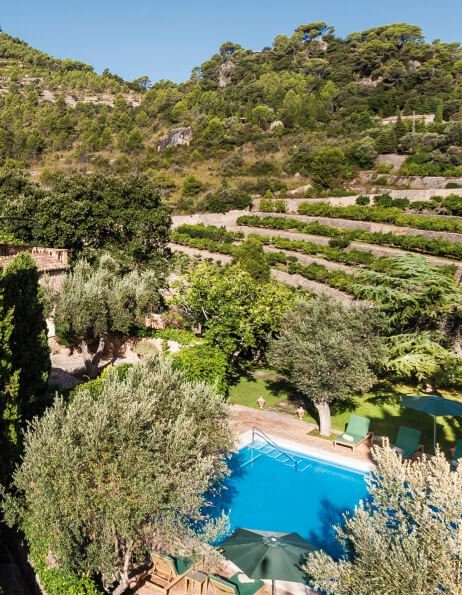
Built where the water once decided to run and has never quite stopped — you can hear it, sometimes, beneath the floors. Beyond the walls, there is little else to hear: birdsong, sheep somewhere further up the hillside, the stillness of a valley that belongs to the Sierra de Tramuntana, a UNESCO World Heritage Site. Art by Richard Zinnon, Antonia Ferrer and Jordi Alcaraz sits among furniture worn soft by generations — as if this sanctuary had chosen what to keep.
Both rest on the same mountain: dry-stone terraces raised by hands long forgotten, olive groves that have outlived the memory of who planted them.